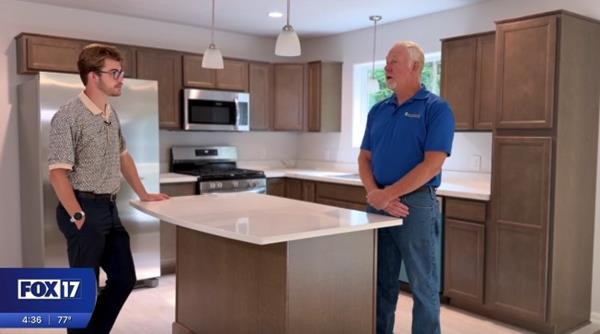
Sable Homes President John Bitely explains barriers impacting home ownership as NAHB calls on Congress to address housing affordability
More than 1,100 home builders, housing industry professionals and National Association of Home Builders (NAHB) members from across the country this week called on Congress to take action to address America's housing affordability crisis, urging lawmakers to remove regulatory barriers that increase housing costs and limit housing supply.
NAHB is calling on Congress to pursue regulatory reforms that would help make homeownership more attainable for American families. The effort comes as new NAHB research found that regulations imposed at the federal, state and local levels now add an average of $131,734 to the cost of a new single-family home, with regulatory costs increasing 40% over the past five years.
As policymakers debate solutions, West Michigan homebuilder and housing advocate John Bitely, president of Sable Homes, explains how regulations, permitting delays and rising costs are affecting housing affordability locally and what can be done to increase the supply of attainable housing for working families.
“For years, we've been talking about the need for more workforce housing in Michigan, but it becomes increasingly difficult to deliver when regulatory costs, permitting delays and other barriers continue to drive up the price of construction,” said Bitely. “If we want teachers, nurses, first responders and young families to have a path to homeownership, we need policies that support housing production rather than making it more expensive.”
Bitely has spent decades advocating for workforce and attainable housing across Michigan, regularly engaging with state lawmakers, local officials and industry leaders on policies that impact housing supply and affordability.
“Our national (association) has determined that nearly 30 percent of every new house is regulation-borne cost," Bitely said in an interview with WOOD Radio. “And that's a huge number. You're looking at, like, $100,000 for a house or more. So, all of that regulation isn't helping the end consumer by regulating them to the point they can't afford to buy them.
“Every $1,000 matters,” Bitely told the state House Regulatory Reform Committee during a presentation last March. “As a builder, we repeatedly hear it’s only $500 – it’s only $500 for this regulation, it’s only $500 for that regulation. If you look at the regulation costs of about $94,000 per home, that is over 25 percent of a new home. We can’t continue to build housing for anyone in a reasonable price range when we have to spend over $90,000 in fees and regulation.”
NAHB is urging the Senate to adopt two House-approved changes to the 21st Century ROAD to Housing Act: eliminate the single-family rental sale mandate and raise and index multifamily loan limits. According to estimates by NAHB and the Urban Institute, this policy change could result in 40,000 to 70,000 fewer single-family rental homes being built each year than would otherwise be expected. Updating multifamily loan limits would better reflect construction costs and support new apartment development.
“Members of the housing community from across the country are in Washington for the National Association of Home Builders (NAHB) 2026 Legislative Conference to call on lawmakers to advance major housing legislation and enact policies that will let builders build,” said NAHB Chairman Bill Owens, a home builder and remodeler from Worthington, Ohio.
Additionally, NAHB is calling on Congress to pass the CONSTRUCTS Act (H.R. 1055/S. 189), bipartisan legislation pending in the House and Senate that would help prepare young adults for rewarding careers in the skilled trades; and the Energy Choice Act (H.R. 3699/S. 1945), which would prevent state and local governments from banning the use of natural gas in new homes.
While policy changes are critical to addressing long-term affordability challenges, Sable Homes continues to focus on what it can control in the meantime.
“Families in West Michigan are feeling the pressure of rising housing costs, and we see that every day,” said Bitely. “That’s why Sable Homes is committed to doing everything we can to keep homeownership within reach through smarter design, efficient building and a relentless focus on value.”
Sable Homes is consistently exploring ways to deliver attainable housing by refining home designs, optimizing construction efficiencies and identifying opportunities to control costs wherever possible. These efforts are part of Sable Homes’ ongoing commitment to helping more West Michigan families access quality, affordable homeownership, even in a challenging market.
As conversations around housing affordability continue, Sable Homes remains committed to being part of the solution, both through advocacy and by continuing to build homes that meet the needs of today’s West Michigan home buyers.
In the Media:
WOOD Radio: Red tape pricing families out of homeownership in West Michigan